Articles
TCM Confinement Herbs for Non-Chinese Mothers in Singapore
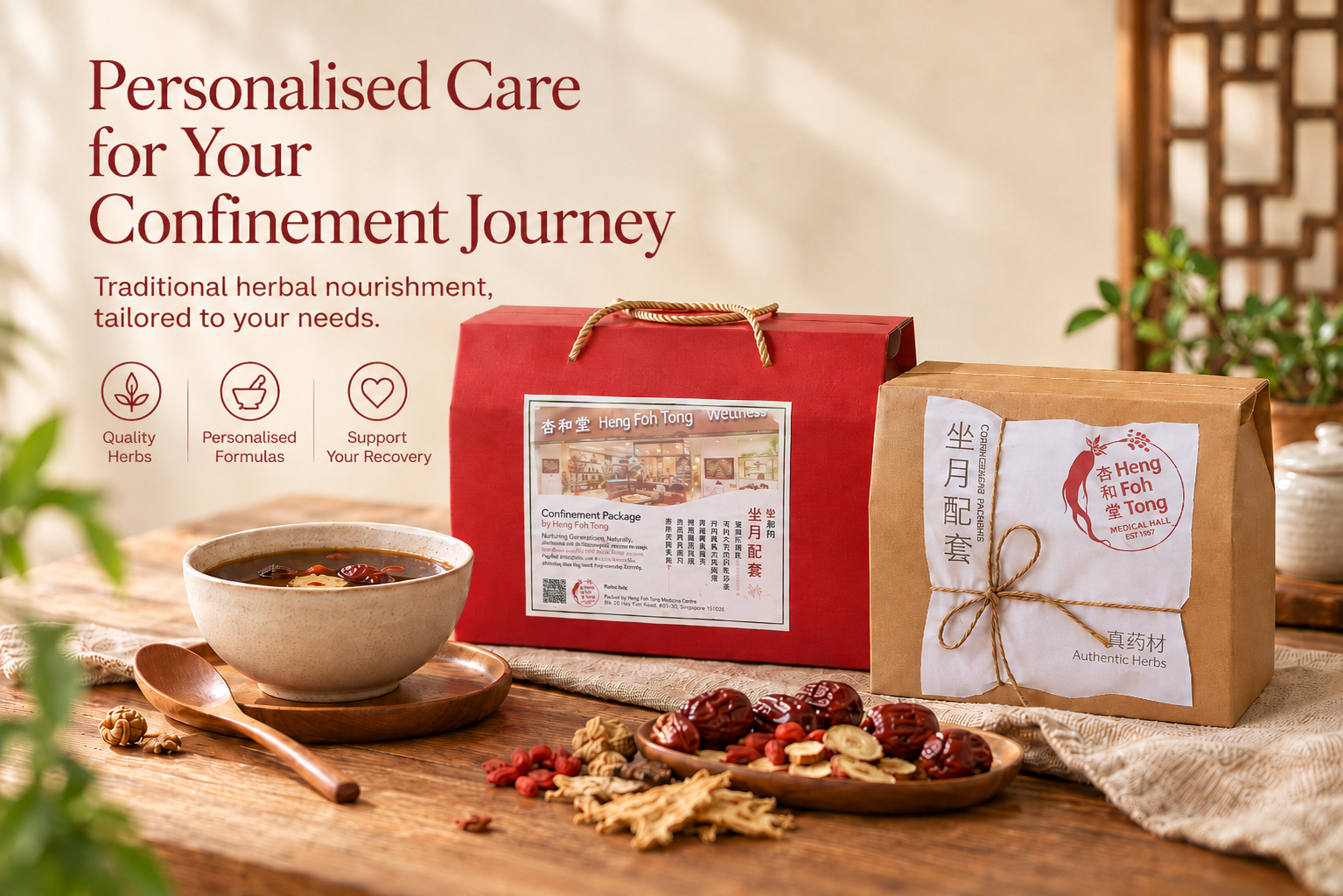
Navigating TCM confinement herbs for non-Chinese mothers can feel unfamiliar at first, especially when you are handed packets of dried roots, fruits and herbs you may never have seen before.
But Traditional Chinese Medicine (TCM) confinement practices are not inherently limited to any particular ethnicity. They are based on traditional approaches to postpartum nourishment and recovery, and many aspects can be adapted to suit different dietary requirements, cultural preferences and individual needs.
Heng Foh Tong, a heritage medical hall in Singapore established in 1957, prepares personalised confinement herbal packages for mothers with different recovery needs. All Heng Foh Tong confinement herbal packages are plant-based and vegetarian suitable, making them easier to incorporate into a wide range of dietary and cultural preferences.
This guide explains what confinement herbs are traditionally used for, how they can be prepared at home, what non-Chinese mothers may want to consider, and why personalisation matters when choosing a confinement herbal package.
Quick Summary
TCM confinement herbs are traditionally used to support postpartum nourishment and recovery.
Confinement practices are not limited to Chinese mothers and can be adapted to different cultural preferences.
Heng Foh Tong confinement herbal packages are plant-based and vegetarian suitable.
Preparation usually involves rinsing the herbs before boiling or simmering them according to the instructions provided.
Personalised packages can take birth type, allergies, lactation considerations and dietary preferences into account.
Mothers taking medication or managing medical conditions should inform both their healthcare provider and herbal dispenser before beginning any herbal programme.
TCM Confinement Herbs: What Non-Chinese Mums Need to Know
Traditional Chinese Medicine confinement herbs are dried herbal blends traditionally brewed into soups, teas and other preparations during the postpartum confinement period.
Depending on the family and tradition, confinement may last around 28 days or longer.
Rather than viewing confinement herbs as something specifically for Chinese mothers, it may be more helpful to understand them as part of a traditional postpartum recovery practice that can be adapted according to the individual.
Confinement in TCM: A Simple Explanation
Confinement, commonly associated with the Chinese practice of zuo yue zi (坐月子), refers to a period of rest and postpartum care following childbirth.
Within Traditional Chinese Medicine, childbirth is traditionally understood as a period in which the mother has expended significant qi, or vital energy, and blood. The postpartum period therefore focuses on gradual nourishment, rest and rebuilding.
Depending on the individual and stage of recovery, herbs may be prepared as soups, teas or herbal baths.
The traditional emphasis is on keeping the body comfortably warm, eating nourishing meals and allowing sufficient time for recovery. These practices should complement, rather than replace, appropriate postnatal medical care.
Are Confinement Herbs Only for Chinese Mums?
No.
TCM confinement practices are cultural in origin, but a mother does not have to be Chinese to choose to incorporate suitable aspects of them into her postpartum routine.
Families from different cultural backgrounds may already have their own postpartum traditions involving rest, warm foods, nourishing soups and family support.
For example, there are similarities between certain aspects of Chinese confinement, Malay berpantang, Indian postnatal traditions and other cultural approaches to postpartum care.
The specific herbs and practices do not need to be identical. What matters is choosing an approach that is suitable for the mother’s recovery needs, dietary requirements, personal preferences and medical circumstances.
Dietary Concerns Non-Chinese Mums Ask About
Plant-based and vegetarian suitability: Heng Foh Tong’s confinement herbal packages are plant-based and suitable for vegetarians. The herbal preparations are centred around dried herbs, roots, fruits and other plant-based ingredients, allowing them to fit more easily into different dietary preferences.
Flexible preparation: Herbal soups can be prepared according to the instructions provided, while families may decide whether to incorporate other suitable ingredients into their meals separately according to their own dietary preferences.
Dietary adjustments: Mothers following vegetarian or other specific dietary requirements should communicate these preferences before the herbs are dispensed so that the overall confinement programme can be planned accordingly.
Ingredient adjustments: Alcohol-containing preparations, strongly flavoured herbs or ingredients that the mother cannot consume may sometimes be adjusted depending on the formula and individual circumstances.
Medical considerations: Always declare allergies, existing health conditions and medications to the herbal dispenser. Conditions such as gestational diabetes, hypertension or thyroid disorders may require additional consideration.
Personalisation should take place before the confinement herbs are prepared rather than after the programme has already begun.
Why Does Confinement Matter in Singapore’s Climate?
Postpartum confinement is fundamentally a period of rest and recovery after childbirth.
Within TCM tradition, mothers are also encouraged to avoid excessive exposure to cold environments and direct drafts during this period.
Singapore presents an interesting environment because the weather outdoors is hot and humid, while indoor spaces are often heavily air-conditioned.
For mothers following traditional confinement practices, the goal is generally not to avoid air-conditioning completely, but to remain comfortable and avoid prolonged direct exposure to cold air.
Rebuilding Qi and Blood After Birth
Within Traditional Chinese Medicine, childbirth and blood loss are traditionally associated with depletion of qi and blood.
Warming and nourishing soups are therefore commonly incorporated into confinement meals as part of the recovery process.
Modern postpartum care similarly places importance on adequate nutrition, hydration, rest and appropriate medical follow-up.
However, TCM concepts such as qi and blood should not be interpreted as identical to biomedical concepts such as iron levels or blood volume.
Mothers who have experienced significant blood loss, anaemia or other postnatal complications should follow the advice of their healthcare professionals.
A structured confinement period may also provide something extremely practical: protected time for the mother to rest while family members, partners, helpers or confinement nannies assist with meals and newborn care.
Humidity, Air-Conditioning and “Wind” Explained
In Traditional Chinese Medicine, postpartum mothers are traditionally believed to be more vulnerable to what is described as wind or cold entering the body.
This is a TCM concept rather than a modern medical diagnosis.
Traditional practices may therefore include:
Avoiding direct air-conditioning or strong fan drafts
Keeping the shoulders and body comfortably warm
Drinking warm beverages
Using traditional herbal baths where appropriate
Eating warm, freshly prepared meals
These practices can be followed according to personal comfort while still maintaining a safe and well-ventilated living environment.
Which Herbs Are Commonly Used During Confinement?
Confinement formulas vary significantly depending on the individual mother, stage of recovery and purpose of the preparation.
However, several ingredients commonly appear in traditional teas and nourishing soups.
Red Dates, Longan and Dang Shen Explained
| Herb | Chinese / Pinyin Name | Traditional Role | Common Use |
|---|---|---|---|
| Red Dates / Jujube | Hong Zao (红枣) | Traditionally regarded as nourishing and commonly used to add gentle sweetness | Teas and nourishing soups |
| Dried Longan | Long Yan Rou (龙眼肉) | Traditionally regarded as warming and nourishing | Teas and selected confinement preparations |
| Dang Shen / Codonopsis | Dang Shen (党参) | Traditionally used in TCM to support qi | Nourishing soups and tonic preparations |
These herbs are examples rather than a universal formula.
The actual combination, quantity and timing should depend on the confinement programme and the mother’s individual needs.
A simple red date or herbal tea may also be included in some confinement programmes as a warm, caffeine-free beverage.
Herbs Commonly Used Around Lactation Needs
Breastfeeding and lactation requirements should be discussed before confinement herbs are dispensed.
Depending on the individual:
Certain herbs may be incorporated into a programme when lactation support is required.
Other herbs or stronger tonic preparations may be delayed or adjusted.
Herbal teas may be selected according to the mother’s overall programme and preferences.
Adequate hydration, regular feeding or expressing, nutrition and appropriate lactation support remain important.
At Heng Foh Tong, lactation considerations can form part of the personalisation process when preparing a mother’s confinement programme.
You can also watch this feature on Heng Foh Tong and lactation support:
Watch the feature on YouTube
Herbal preparations should not be presented as a guaranteed way to increase breast milk supply. Mothers who are experiencing persistent concerns about milk supply should speak with an appropriate healthcare professional or lactation consultant.
Herbs and Soups After a Caesarean Birth
Mothers recovering from a Caesarean delivery may require a different sequence from mothers who have had a vaginal delivery.
Within traditional confinement practice, stronger tonic preparations are often introduced more gradually while the mother focuses on early recovery.
Certain traditional formulas, including Sheng Hua Tang (生化汤), may also be used differently depending on birth type, bleeding and individual circumstances.
The exact timing should not be generalised.
Caesarean mothers should inform their herbal dispenser of their birth type and follow the medical advice given by their obstetrician, particularly while recovering from surgery or taking medication.
How Do You Cook Confinement Herbs Step by Step?
Preparing confinement herbs is usually straightforward once the packets have been organised.
Many confinement packages are prepared according to a planned sequence so that the mother or caregiver knows what to cook each day.
Always follow the specific preparation instructions supplied with your herbal packet, as different formulas may require different quantities of water and cooking times.
Step 1: Rinse and Prepare Your Herb Packet
Action: Open the packet assigned for the day and prepare the herbs according to the instructions provided.
Where appropriate, gently rinse the herbs before cooking.
Tools: A colander, standard soup pot or slow cooker is usually sufficient.
Tip: If additional ingredients are being incorporated into the meal, prepare them according to your dietary requirements and the instructions provided.
Keeping each day’s herbs clearly labelled also makes the programme easier for partners, family members, helpers or confinement nannies to follow.
Step 2: Boil, Simmer and Serve
For confinement herbal soups, the herbs are typically simmered with water according to the recipe provided.
Depending on the formula and cooking method, preparation may take approximately one hour or longer.
Herbal teas generally require less preparation time.
Where a specific water quantity or cooking duration is supplied with the packet, follow those instructions rather than relying on a general recipe.
A slow cooker may also be useful for households that prefer a more hands-off preparation method.
Step 3: Build the Routine Around Your Day
Morning preparation: Preparing the day’s soup earlier can make the rest of the day easier.
Meal pairing: Herbal soups can be incorporated into regular meals according to the confinement plan.
Delegation: Partners, family members, helpers or confinement nannies can manage the daily labelled packets on behalf of the mother.
Storage: If a prepared soup is being kept for later consumption, refrigerate it appropriately and reheat it thoroughly before serving.
The goal is to make confinement nourishment manageable rather than turning every meal into another task for a recovering mother.
5 Confinement Herb Mistakes First-Time Mums Make
First-time mothers may find confinement confusing simply because there are so many products, traditions and recommendations available.
Avoiding a few common mistakes can make the process considerably easier.
1. Buying Random Herbs Without Guidance
Generic herb bundles may not take the mother’s birth type, allergies, dietary requirements or medical history into account.
The quality, ingredients and quantities can also vary between suppliers.
Where possible, choose a provider that can explain what is included and how the formula fits into the overall confinement programme.
Personalisation is particularly important when the mother has known allergies, medical considerations or specific dietary requirements.
2. Ignoring Allergies and Medical Conditions
Always disclose relevant health information before the herbs are prepared.
Important considerations may include:
Gestational diabetes
Hypertension
Thyroid conditions
Food or herbal allergies
Significant postpartum bleeding
Caesarean recovery
Current medication
Breastfeeding or lactation requirements
Some preparations may need to be adjusted or introduced later depending on the mother’s recovery.
If you are taking medication or have experienced complications following childbirth, discuss herbal products with your healthcare professional.
3. Assuming Every Mother Needs the Same Formula
A confinement package should not simply be a collection of identical herbal packets.
Different mothers may have different requirements based on:
Birth type
Stage of recovery
Lactation plans
Allergies
Health considerations
Dietary requirements
Taste tolerance
The same mother may also require different preparations at different stages of confinement.
4. Starting Strong Tonics Too Early
Traditional confinement programmes are often arranged in stages.
Preparations used during the early postpartum period may therefore differ from those introduced later.
A stronger tonic is not necessarily better, particularly immediately after delivery.
Follow the sequence provided by your herbal dispenser and inform them if your recovery circumstances change.
5. Treating the Programme as Fixed
Recovery can change from week to week.
A mother who has undergone an unexpected Caesarean delivery, develops a medication requirement, experiences breastfeeding difficulties or finds a particular ingredient unsuitable may need adjustments.
A good confinement programme should therefore allow communication between the mother and the dispenser rather than assuming the original plan can never change.
How to Choose a Confinement Herb Package in Singapore
Choose a confinement package according to the length and type of support you need, but look beyond the number of packets in the box.
The more important question is whether the programme can be adapted to your individual circumstances.
For mothers with particular dietary requirements, it is also helpful to know that Heng Foh Tong’s confinement herbal packages are plant-based and vegetarian suitable, while still allowing the overall programme to be personalised according to individual needs.
14-Day vs 28-Day vs 38-Day Packages
Different confinement providers structure their packages differently.
A general comparison may look like this:
| Package Length | Typical Focus | May Suit |
|---|---|---|
| First 14 Days | Early-stage recovery soups and preparations | Mothers who want a shorter programme or only the initial confinement stage |
| Around 28 Days | Broader confinement programme covering several stages of recovery | Mothers following a standard month-long confinement period |
| Around 38 Days | Extended programme with additional later-stage preparations | Mothers who prefer a longer traditional confinement period |
Exact contents vary between packages and providers.
Before purchasing, check what is actually included rather than comparing packages by duration alone.
Why Personalisation Matters More Than Price
Two packages with the same number of herbal packets may still be very different.
Important considerations include:
Birth type: A vaginal delivery and a Caesarean delivery may require different timing or adjustments.
Lactation needs: Breastfeeding plans should be taken into account when the herbs are selected.
Allergies and health considerations: These should be identified before dispensing.
Dietary preferences: Vegetarian requirements, alcohol-containing preparations and other dietary considerations should be communicated before dispensing. Heng Foh Tong’s confinement herbal packages are plant-based and vegetarian suitable.
Taste preferences: If the mother cannot tolerate a particular flavour or herb, this should be discussed.
Preparation and freshness: Ask when and how the herbs are dispensed and packed.
Support: Find out whether you can contact the provider if your recovery needs change during confinement.
Heng Foh Tong has been operating in Singapore since 1957, bringing decades of traditional herbal dispensing experience to its confinement preparations.
Questions to Ask Before You Order
Before choosing a confinement herbal package, consider asking:
Can the herbs be adjusted according to my birth type?
Will my breastfeeding or lactation plans be taken into account?
Can you accommodate my allergies or dietary restrictions?
Are the packages plant-based and suitable for vegetarians?
What happens if I undergo an unexpected Caesarean delivery?
Are the herbs packed according to different stages of confinement?
Will I receive clear cooking instructions?
Who can I contact if my circumstances change after delivery?
When should I place my order relative to my estimated due date?
What exactly is included in the package?
Is a consultation available before the herbs are prepared?
These questions often reveal more about a confinement programme than price alone.
Start Your Confinement Journey With Confidence
TCM confinement herbs may seem unfamiliar if you did not grow up with the tradition, but the process does not need to be intimidating.
At its core, confinement is about giving a mother time to rest, eat well and recover after childbirth.
Traditional Chinese Medicine adds its own framework of staged nourishment, herbal soups, teas and other practices.
For non-Chinese mothers, there is no requirement to adopt every traditional practice. Suitable elements can instead be incorporated in a way that respects your dietary requirements, cultural preferences, medical circumstances and personal comfort.
For those following a vegetarian diet, Heng Foh Tong’s confinement herbal packages are plant-based and vegetarian suitable, providing greater flexibility while retaining the traditional herbal approach to confinement.
Most importantly, confinement herbal programmes should not be one-size-fits-all.
Your birth type, allergies, lactation plans, recovery progress, dietary requirements and individual preferences should all be considered before the herbs are dispensed.
If you are considering a Heng Foh Tong confinement package, speak with the team about your individual requirements and the package options available before your estimated due date.
Can non-Chinese mothers take TCM confinement herbs?
Yes. TCM confinement practices are not limited by ethnicity and can be adapted to suit different dietary requirements, cultural preferences, allergies and individual recovery needs.
Is Heng Foh Tong suitable for non-Chinese mothers?
Yes. Heng Foh Tong can prepare confinement herbal programmes based on factors such as birth type, lactation plans, dietary requirements, allergies and personal preferences.
Are Heng Foh Tong confinement packages vegetarian?
Yes. Heng Foh Tong’s confinement herbal packages are plant-based and vegetarian suitable. Mothers with additional dietary requirements should communicate them to the team before their package is prepared so that these needs can be taken into account.
Where can I buy confinement herbs in Singapore?
Heng Foh Tong provides confinement herbal packages in Singapore. Before ordering, check the latest package options, delivery or collection arrangements, and recommended ordering timeline directly with the team.
How long should the confinement period last?
A traditional Chinese confinement period is commonly around one month, although some families follow shorter or longer programmes depending on their recovery needs, preferences and chosen package.
Are confinement herbs safe after a Caesarean birth?
They may be suitable when appropriately adjusted. Mothers recovering from a Caesarean delivery should inform both their herbal dispenser and obstetrician, as the timing and selection of certain herbs or tonics may need to be modified.
Do confinement herbs affect breast milk supply?
It depends on the ingredients and the individual mother. Some formulas may take lactation needs into account, while certain herbs may be adjusted or delayed, so breastfeeding plans should be discussed before the programme is prepared.
Heng Foh Tong takes lactation considerations into account as part of its personalised confinement planning. You can also watch this feature on Heng Foh Tong and lactation support on YouTube.